AI is making parts of an attacker’s job faster, cheaper and more accessible. Businesses need a regular way to check what they expose—and act on what they find.
Your company does not need to use artificial intelligence to be affected by it.
The people looking for weaknesses in your websites, servers and online services can use AI regardless of your own technology strategy. It can help them research your infrastructure, interpret technical information and investigate possible ways in.
That changes the economics of looking for targets. When research takes less effort, more systems can be examined. When technical guidance becomes easier to obtain, more people can attempt tasks they previously struggled with.
For a business, the question becomes practical: how confidently can you identify your own weak points before someone else investigates them?
What has become easier for attackers?
Automated scanning existed long before generative AI. Internet-facing systems were already being searched for exposed databases, vulnerable applications and poorly protected access points.
AI adds assistance to the work around those tools.
It can help an operator organise public information, understand unfamiliar software, interpret responses from services and produce scripts for repetitive tasks. Someone with limited experience can ask for explanations and guidance. A skilled operator can use the same assistance to move through familiar work faster.
The Netherlands’ National Cyber Security Centre warned in September 2026 that AI is lowering barriers to entry for attackers and helping a broader range of malicious actors conduct cyberattacks. It also stressed that existing, readily accessible models can already be useful for these purposes. Read the NCSC-NL assessment.
This does not make expertise irrelevant. Finding a possible weakness, confirming it and successfully exploiting it remain different tasks. AI-generated conclusions and code can be wrong.
The UK’s NCSC makes that distinction in its November 2026 assessment: it expects AI to increase the speed, scale and efficiency of existing methods, with human operators remaining important and skilled attackers gaining substantial benefits. Read the NCSC assessment.
For businesses, even partial assistance matters. An attacker does not need AI to complete every step if it makes the next useful step easier.
Ordinary weaknesses become harder to ignore
Much of the resulting risk will look familiar.
A forgotten website still runs an application nobody updates. An administrative interface is reachable from the internet. A server exposes a database that should only be accessible internally. A downloadable backup contains information the company assumed was private.
These weaknesses can exist alongside well-maintained production systems. Responsibility may be split between employees, hosting companies, developers and other contractors.
Four types of exposure deserve particular attention:
- Assets missing from the inventory. Old campaign sites, test environments and temporary services can outlive the work that created them.
- Software whose security status is unclear. The company knows a service exists but cannot establish whether relevant fixes are installed.
- Unnecessarily accessible services or files. Management interfaces, storage systems and configuration files may reveal more than intended.
- Exposed credentials. Corporate account details found in known leaks require investigation, particularly where access may still be valid.
The consequences depend on what those systems connect to and contain: customer data, business applications, administrative access or services that generate revenue.
A useful assessment therefore connects an observation with its possible impact. An open interface deserves investigation; its presence alone does not establish that the business has been compromised.
Your business can change less than its risk does
A company may believe its security position is stable because it has launched nothing new.
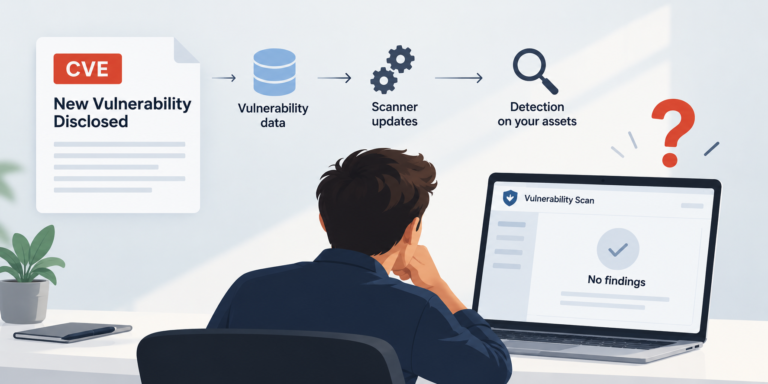
Yet a newly disclosed vulnerability can affect software it already operates. A supplier can change a configuration. A temporary service can remain accessible after its owner considers the project finished.
The effort required to investigate that exposure can also change outside the company’s control.
The implication is straightforward: “nothing has changed here” is insufficient evidence that the risk remains the same.
Leadership needs a way to establish what is currently exposed, what has changed and which observations require action. That requires ownership as well as tools. Every significant asset should have someone who can explain its purpose and arrange a fix, restriction or retirement.
Otherwise, a discovered problem can remain unresolved while different teams decide whose responsibility it is.
Regular checks need a purpose and a schedule
A security assessment provides evidence about the systems and conditions examined at that time. Its usefulness depends partly on how much changes afterwards.
Businesses should combine three kinds of checking.
Repeat external checks on a defined schedule. Maintain an inventory of internet-facing assets and investigate new services, weaknesses and changes. Choose the frequency according to business criticality, the pace of change and the team’s ability to respond.
Check after significant events. A new application, hosting migration, change to remote access or critical vendor advisory can justify an additional assessment before the next scheduled review.
Use deeper testing for important systems. Applications and APIs can contain access-control and business-logic weaknesses that require targeted investigation. A broad external scan cannot answer every question about how a customer portal handles sensitive operations.
These activities need to lead to decisions. Discovering the same unresolved exposure repeatedly provides little additional protection.
Finding more problems creates another business challenge
Teams need capacity to validate findings and carry out remediation.
In its September 2026 review of financial firms, the UK’s Financial Conduct Authority reported that AI-assisted vulnerability discovery was increasing pressure on validation, prioritisation and remediation processes. Firms still relied on human expertise to assess relevance and decide what to do. These observations concern financial services, but they raise a useful question for other businesses: can the organisation act on the problems its tools reveal? Read the FCA review.
For each material finding, a business should establish:
- what the evidence supports and what remains uncertain;
- which system and business activity are affected;
- who will act and by when;
- how the result will be verified.
Prioritisation should consider exposure, evidence of exploitability and business consequences alongside technical severity. A potentially vulnerable public service supporting customer transactions may require a different response from an isolated system with effective access restrictions.
Closing the work also requires evidence. The team should establish that the fix is in place or the exposure has been removed.
Continuous Monitoring and Periodic Security Assessments
Keeping track of external security risks requires more than occasional vulnerability scans. Businesses need a combination of continuous monitoring and periodic in-depth security assessments.
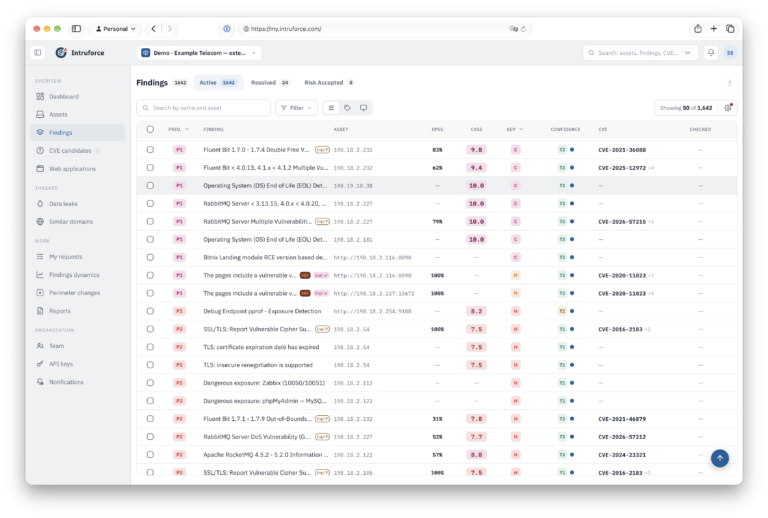
Continuous external monitoring helps organisations maintain visibility into their internet-facing infrastructure. It can identify newly exposed assets, detect known vulnerabilities, highlight potentially exposed credentials and track changes over time. This provides an ongoing picture of the external attack surface rather than a snapshot taken during an annual assessment.
Periodic security assessments provide a deeper examination of critical systems, applications and APIs. Penetration testing and specialised security reviews can uncover weaknesses that automated tools may miss, including complex access-control issues, business-logic flaws and vulnerabilities that become significant when combined.
These approaches complement each other. Monitoring helps identify what has changed and where attention may be needed. Deeper assessments help determine whether important systems can withstand realistic attack scenarios.
Neither approach eliminates the need for remediation. Findings must be validated, prioritised and assigned to responsible teams. The objective is not simply to discover more vulnerabilities, but to reduce exposure before those weaknesses can be exploited.
Start with what you can establish today
A useful leadership discussion can begin with five questions:
- Which of our systems are accessible from the internet?
- Who is responsible for each one?
- When were they last checked, and what has changed since?
- Which significant findings remain unresolved?
- What evidence confirms that completed fixes worked?
If those answers are unclear, an assessment of the external perimeter is a practical starting point.
AI is making it easier for others to investigate your weaknesses. Regular checks give your business a way to investigate them too—and the opportunity to act first.
Find Out What Your Business Exposes Today
In partnership with IntruForce, we’re offering readers the opportunity to get a free initial assessment of their company’s external attack surface, with no obligation.
You can request an assessment from IntruForce’s specialists or explore SeguriScan, its external security monitoring platform, yourself.